Problem Idea Scale Contribution
Flexible models are useful, but often hard to extend
Kernel Regularized Least Squares (KRLS) is attractive because it can learn complex relationships without forcing researchers to specify a rigid functional form. The difficulty is that standard KRLS is not easy to combine with random effects, fixed effects, non-Gaussian outcomes, or newer causal machine-learning workflows.
The paper starts from a practical tension: flexible prediction is valuable, but social-science models also need modular structure and interpretable uncertainty.
Recast KRLS as a modular statistical model
We show that KRLS can be reformulated as a hierarchical model. That shift makes the method easier to combine with familiar components such as random effects, splines, and unregularized fixed effects.
The central move is architectural: KRLS becomes one component in a broader statistical model rather than a standalone black box.
Random sketching makes flexible learning practical
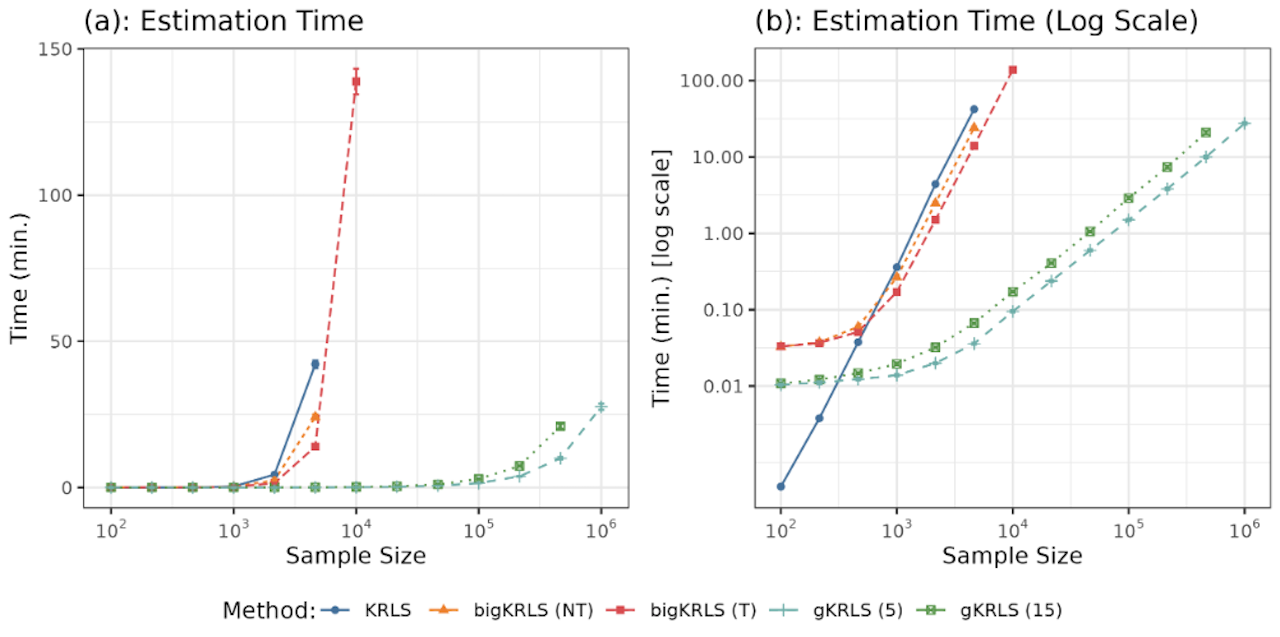
The paper uses random sketching to reduce the computational burden of KRLS. This makes it possible to fit flexible models on datasets with tens of thousands of observations quickly enough for applied workflows.
Random sketching trades a small amount of approximation for a large gain in computational speed.
A flexible method becomes easier to use in serious empirical designs
Generalized KRLS helps researchers keep the flexibility of kernel learning while adding structure that applied social-science designs often require.
The contribution is not only speed. It is a more extensible way to bring statistical learning into interpretable social-science research.
Abstract
Kernel Regularized Least Squares (KRLS) is a popular method for flexibly estimating models that may have complex relationships between variables. However, its usefulness to many researchers is limited for two reasons. First, existing approaches are inflexible and do not allow KRLS to be combined with theoretically motivated extensions such as random effects, unregularized fixed effects, or non-Gaussian outcomes. Second, estimation is extremely computationally intensive for even modestly sized datasets. Our paper addresses both concerns by introducing generalized KRLS (gKRLS).